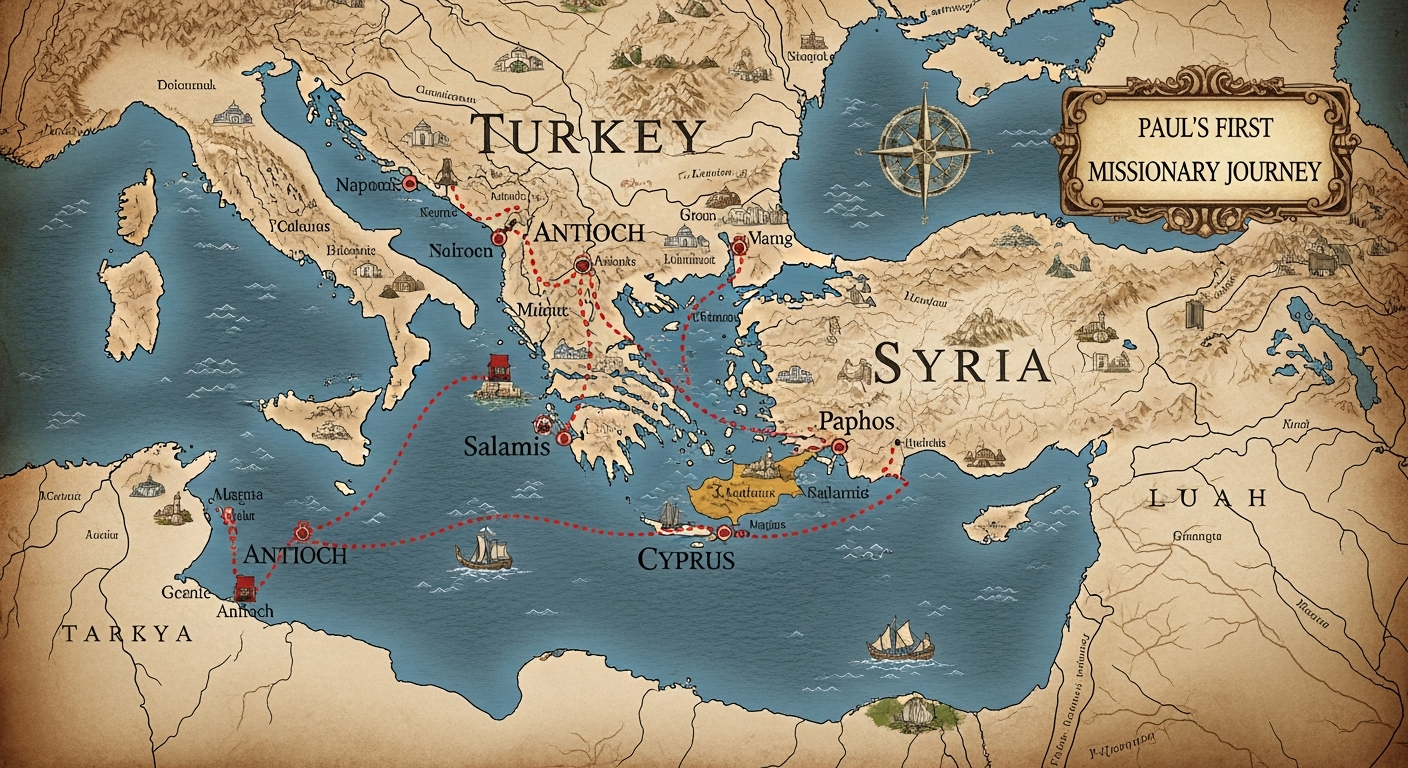
paul’s first missionary journey map shows the exciting travels of Paul and Barnabas as they spread the message of Jesus. From the city of Antioch, they sailed to the island of Cyprus and visited cities like Salamis and Paphos, sharing the good news in Jewish synagogues and with local leaders. This journey is important because it marks the first time Paul traveled far from home to teach people about Christianity, facing both friendship and opposition along the way.
Following Cyprus, paul’s first missionary journey map continues into the mainland of Asia Minor, visiting Perga, Pisidian Antioch, Iconium, Lystra, and Derbe. Along the way, they faced challenges, healed the sick, and helped new believers grow strong in their faith. By returning to the cities they had visited, Paul and Barnabas made sure the churches they started could continue even when they were gone. This journey shows courage, faith, and the power of spreading hope across many lands.
paul’s first missionary journey map: From Antioch to Cyprus
paul’s first missionary journey map began in Antioch, where Paul and Barnabas prepared for their trip to share the message of Jesus. They sailed across the Mediterranean Sea to the island of Cyprus, reaching cities like Salamis and Paphos. In each city, they visited Jewish synagogues to teach people about faith in Jesus. Along the way, they faced both support and opposition. At Paphos, they met the Roman leader Sergius Paulus, who became a believer after witnessing a miracle that showed God’s power. This first leg of the journey was important because it set the pattern for Paul’s travels, showing how courage, prayer, and teamwork helped spread the message to new places. It was the start of many adventures and lessons for the early church.
The Samgran-Portal is becoming a centralized digital platform designed to simplify access to online services and administrative data. It aims to bring multiple government or institutional services under one secure login system. With easy navigation and user-friendly features, the portal ensures fast access to essential tools. Many users appreciate its focus on transparency and convenience.
Key Cities on paul’s first missionary journey map
paul’s first missionary journey map shows many important cities where Paul and Barnabas stopped to teach and help new believers. After Cyprus, they traveled to Perga, Pisidian Antioch, Iconium, Lystra, and Derbe in Asia Minor. In each city, they preached in synagogues and to local people, explaining God’s love and hope through Jesus. Some cities welcomed them, while others caused problems, like when Paul was stoned in Lystra but survived. They also healed sick people and encouraged believers to stay strong. These cities became the first Christian communities, and Paul made sure to teach them how to follow Jesus. Traveling from city to city, Paul and Barnabas showed bravery and faith, leaving a strong mark on the people and spreading Christianity across many regions.
Challenges and Miracles Along the Journey
paul’s first missionary journey map includes many challenges and miracles that helped people believe in God’s power. Paul and Barnabas faced opposition from some Jewish leaders who did not like their message. They were even attacked, but God protected them. At the same time, miracles happened that amazed the people, such as healing a lame man in Lystra and stopping a magician in Paphos. These miracles showed that God was with them and gave people courage to believe. The journey teaches us that even when things are hard, faith, prayer, and trust in God can overcome problems. Every challenge and miracle helped the new churches grow and gave Paul and Barnabas strength to keep moving forward on their mission.
How paul’s first missionary journey map Shaped Early Christianity
paul’s first missionary journey map shaped early Christianity by showing how the message of Jesus could reach many places. By visiting synagogues and towns across Cyprus and Asia Minor, Paul and Barnabas taught both Jews and Gentiles about God’s love. They started new churches, trained leaders, and encouraged believers to follow God faithfully. The journey helped people understand that Christianity was not just for one region but for everyone who wanted to believe. Paul’s example of courage, patience, and caring for others inspired the early church to grow. These travels also set a plan for future missions, showing how Christians could move from city to city to teach, help, and build communities of faith for many generations.
Return Trip: Strengthening the New Churches
paul’s first missionary journey map shows that after reaching Derbe, Paul and Barnabas returned to the cities they had visited to strengthen the new churches. They went back through Lystra, Iconium, and Pisidian Antioch, encouraging believers to stay strong and follow Jesus. They appointed leaders to guide the communities and reminded everyone to trust God even when things were hard. This return trip was very important because it helped the new churches last and grow. By revisiting the cities, Paul and Barnabas showed love and care for the people they had taught. The journey proved that teaching, helping, and encouraging others is as important as starting new work. Their commitment helped the early Christian faith spread and stay strong across many regions.
Modern-Day Locations of paul’s First Missionary Journey
paul’s first missionary journey map shows places that are now in modern countries like Turkey and Cyprus. Antioch is in modern Turkey near the Syrian border, and the island of Cyprus still exists today. Cities like Perga, Pisidian Antioch, Iconium, Lystra, and Derbe are also in Turkey. Traveling through these areas, Paul and Barnabas faced mountains, rivers, and roads that were hard to cross, but they still shared the message of Jesus. Knowing the modern locations helps people imagine the journey and see how far Paul traveled. Today, many Christians visit these historic places to learn about the early church and understand the courage and faith of Paul and Barnabas on their first missionary adventure.
Lessons We Can Learn from paul’s First Missionary Journey Map
paul’s first missionary journey map teaches many lessons about faith, courage, and helping others. Paul and Barnabas showed that even when facing danger, people can trust God and keep going. They also demonstrated the importance of teamwork and encouraging new believers. The journey teaches us to be patient, kind, and brave when sharing good news. It shows that helping and teaching others can create communities that grow strong over time. By following their example, people today can learn to spread kindness, courage, and faith, even in difficult situations. The story of the journey reminds us that one person or a small team can make a big difference when guided by love and faith in God.
Conclusion
paul’s first missionary journey map shows how far Paul and Barnabas traveled to share God’s message. They visited many cities, faced danger, and performed miracles that helped people believe. The journey teaches us about courage, faith, and helping others. Even when things were difficult, they never gave up and kept teaching people about Jesus.
The journey also shows that building strong communities is very important. Paul and Barnabas went back to the cities they had visited to help the new believers grow. Their mission spread Christianity to many regions and inspired people to follow God. We can learn from their example that faith, kindness, and perseverance can make a big difference in the world.
FAQs
Q: Where did paul’s first missionary journey start?
A: It started in Antioch, Syria, where Paul and Barnabas prepared for their trip.
Q: Which island did Paul and Barnabas visit first?
A: They first sailed to the island of Cyprus, visiting Salamis and Paphos.
Q: What challenges did Paul face on this journey?
A: He faced opposition from Jewish leaders, was attacked, and even stoned in Lystra.
Q: Which cities in modern-day Turkey were visited?
A: Perga, Pisidian Antioch, Iconium, Lystra, and Derbe are all in modern Turkey.
Q: Why is paul’s first missionary journey important?
A: It helped start new churches, spread Christianity to Jews and Gentiles, and inspired believers to grow in faith.
About the Author